
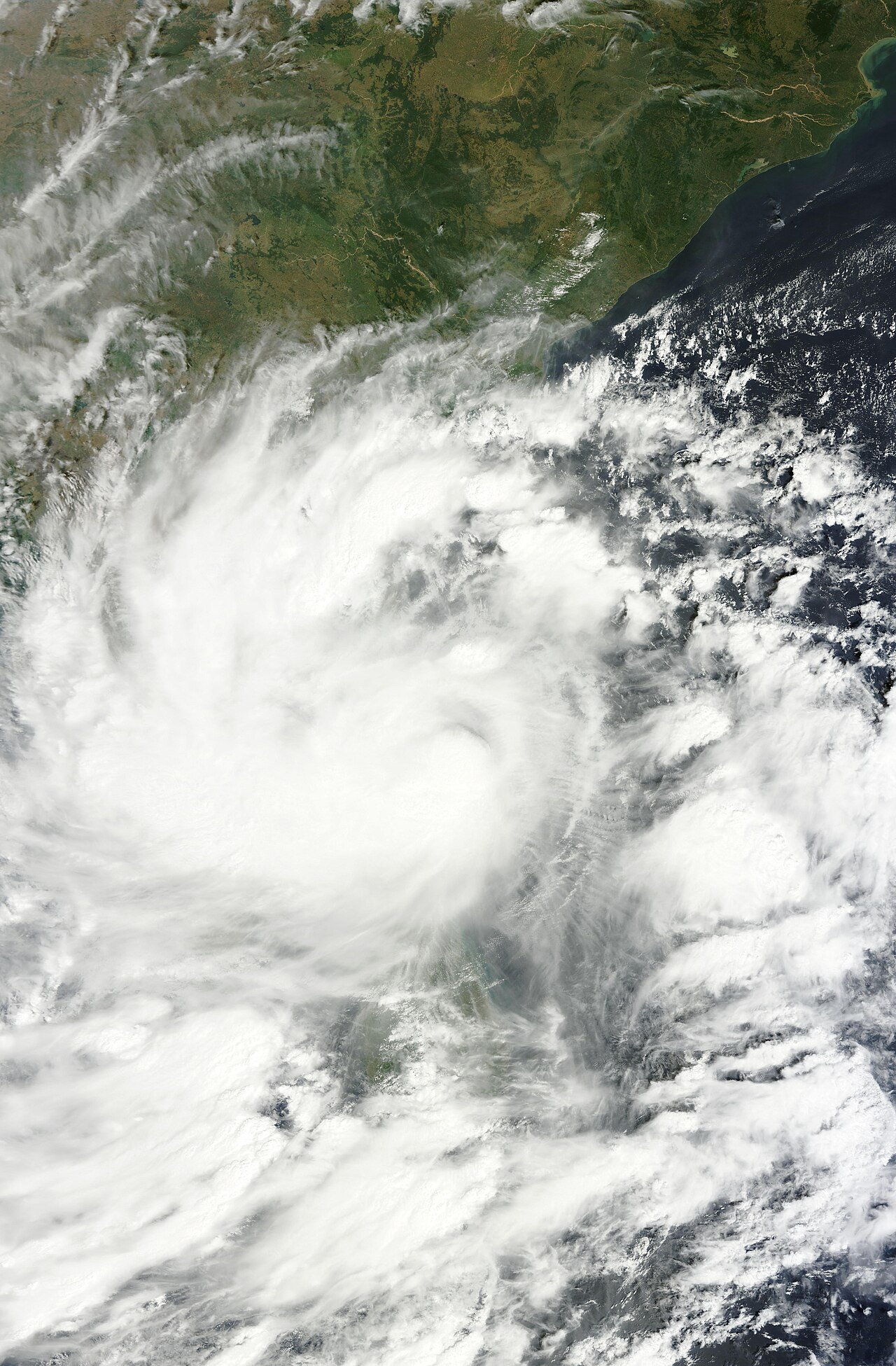
File image: Cyclonic Storm Nilam over the Bay of Bengal on October 31, 2012, seen by NASA’s MODIS instrument. NASA. Cyclonic Storm Nilam Oct 31 2012.jpg. Wikimedia Commons. Source URL. Public domain. Cropped and resized.
Cyclone Murasu is closing in on the Andhra Pradesh coast as a Severe Cyclonic Storm, with landfall expected between Nellore and Narsapur, close to Ongole, late on November 2 or in the early hours of November 3, The Hindu reported. Behind that one-line forecast sit two systems worth understanding: how the IMD grades a storm, and how it gets a name like Murasu.
The wind ladder
The IMD’s official terminology for cyclonic disturbances grades systems by their maximum sustained surface wind. A depression runs at 17 to 27 knots; it becomes a deep depression at 28 to 33 knots, a cyclonic storm at 34 to 47 knots (62 to 88 kmph), and a severe cyclonic storm at 48 to 63 knots (89 to 117 kmph). Beyond that lie the very severe (64 to 89 knots), extremely severe (90 to 119 knots) and super cyclonic storm (120 knots and above) categories.
Where Murasu sits
The IMD’s forecast for Murasu – winds of 100 to 110 kmph gusting to 120 kmph at landfall – puts the storm squarely in the severe cyclonic storm band, below the very severe threshold. Landfall is the moment the storm’s centre crosses the coast; the roughest weather typically begins hours before it and continues after. The IMD’s window for Murasu is between 11:30 p.m. on November 2 and 4 a.m. on November 3.
Who names a cyclone
North Indian Ocean cyclones are named from a list maintained under the WMO/ESCAP Panel on Tropical Cyclones, whose 13 member countries each contribute names. The IMD’s official list shows Murasu was contributed by India; the word means war drum, as The Hindu notes. Names are used in sequence as storms form, which is why each cyclone arrives with its identity already chosen.
The alert colours
Alongside wind categories, the IMD issues colour-coded weather alerts. In its Telangana bulletin for November 2, an orange alert meant heavy to very heavy rainfall in six districts and a yellow alert meant heavy rainfall in five, The Hindu reported. The colours tell people what weather to expect; the wind ladder tells them how strong the storm itself is.
For now, the numbers to watch are the landfall window and the wind band: if Murasu strengthens past 64 knots before crossing the coast, it moves up a category. Official IMD bulletins carry both.