
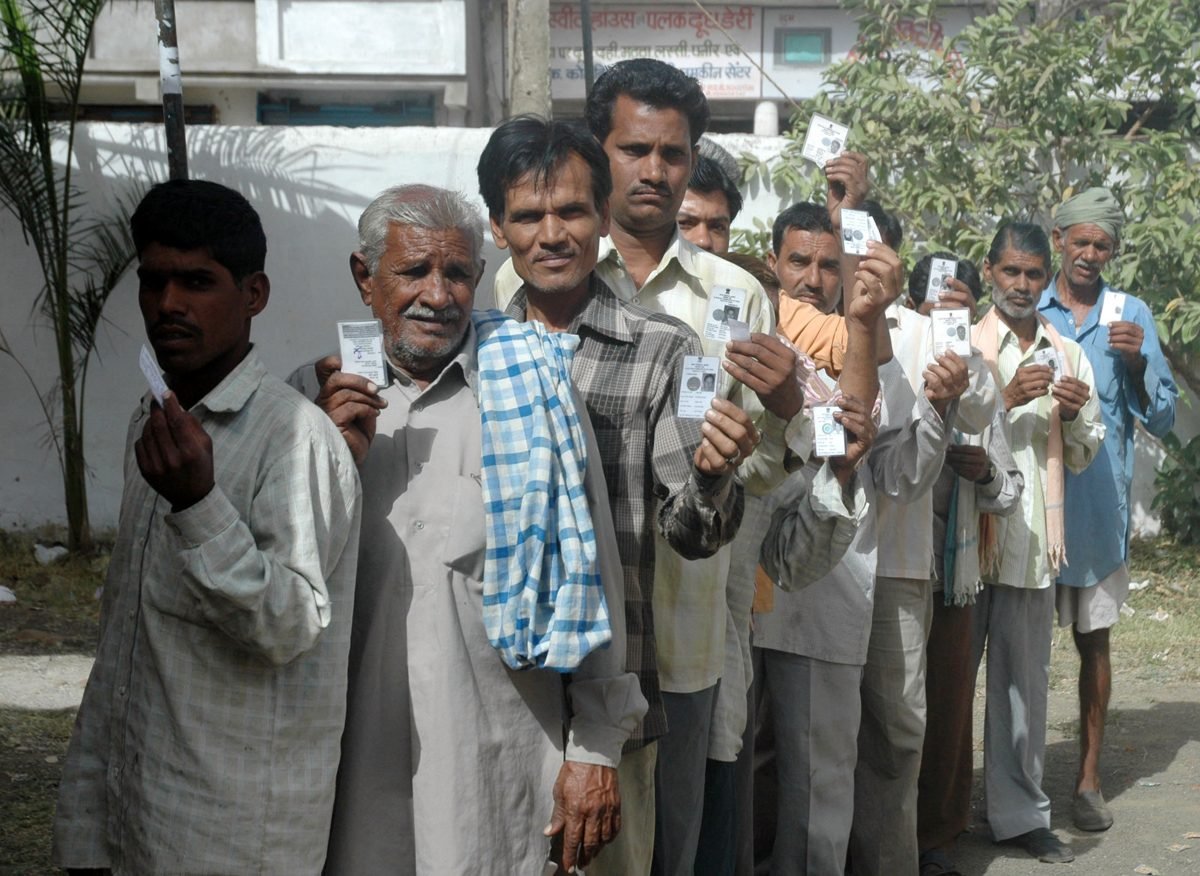
File photo: voters display their identity cards while queueing to vote in Bhopal, April 23, 2009. Election Commission of India. Wikimedia Commons. Source URL. GODL-India. Resized.
An analysis by The Hindu estimates that around 64.5 lakh electors are potentially missing from Karnataka’s final electoral rolls, published on October 27 after the Special Intensive Revision (SIR). The yardstick it used is the elector-to-population, or E-to-P, ratio. Here is what that number means.
The ratio, defined
The E-to-P ratio quoted by the Karnataka Chief Electoral Officer’s (CEO) office is the number of electors on the rolls divided by the estimated 2026 population of all age groups, including those below 18 who cannot vote. Karnataka’s ratio stands at 66.11.
Reading the gap
The CEO’s statements cite the 2020 Report of the Technical Group on Population Projections. That report puts Karnataka’s population on March 1, 2026 at around 6.89 crore, of whom about 5.19 crore would be old enough to vote. The final rolls list 4,54,55,689 electors excluding service voters, a shortfall of roughly 64.5 lakh. Adults are about 75% of the state’s projected population, so a ratio of 66.11 points well below full enrolment.
Where the missing are
Of the potentially missing 64.5 lakh, 38.41 lakh (59.5%) are aged 18 to 29. Only 33.1% of the estimated 18-19 population is enrolled, and the gap narrows steadily in older age groups; in two groups, enrolment even exceeded the estimated population. Thirteen constituencies, mostly in and around Bengaluru, have a ratio below 50.
What it does and does not prove
The ratio is an estimate built on projections, so it cannot identify individual missing voters. Economist Jean Dreze told The Hindu the gap is too large to be explained by projection errors, meaning large numbers were either unfairly deleted or left out of both the pre-SIR and final lists. The CEO office’s own count of deletions, over 99.7 lakh names, was reported by the New Indian Express.