
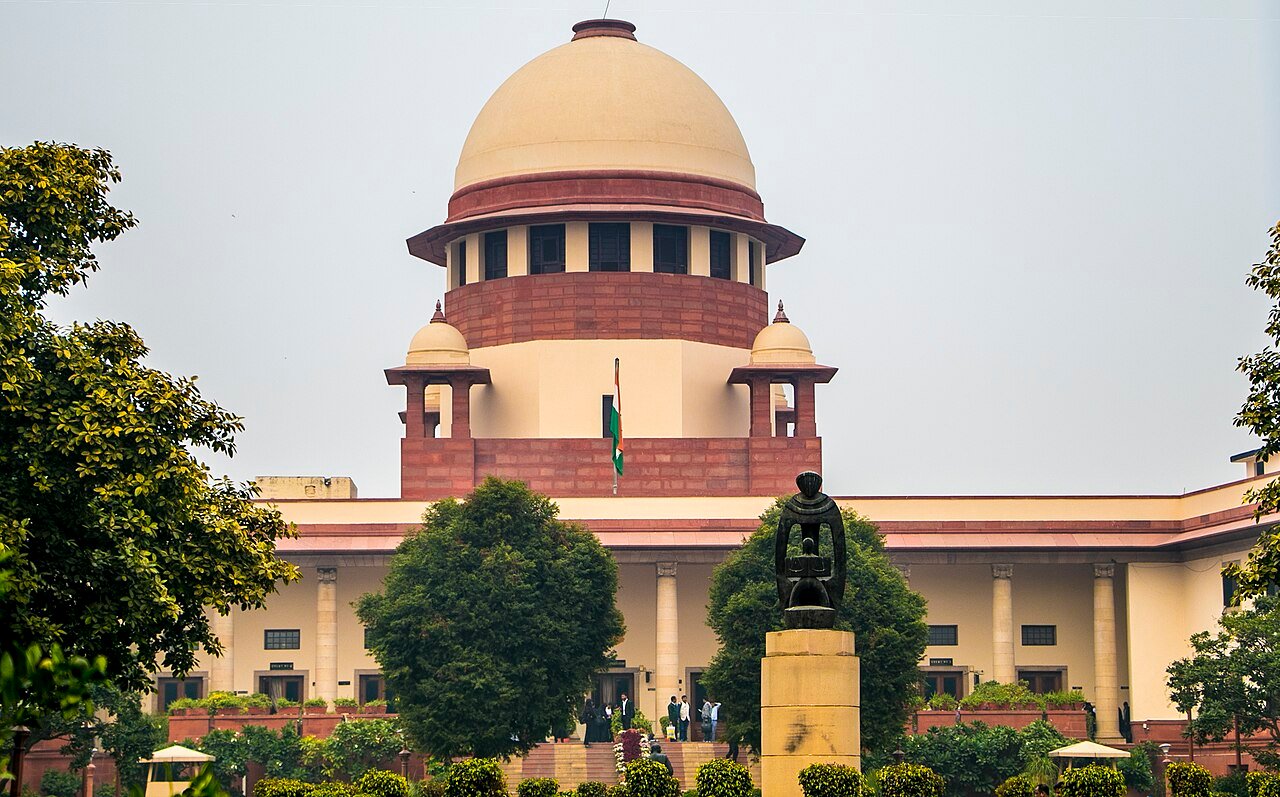
File photo: the Supreme Court of India in New Delhi. Subhashish Panigrahi. Supreme Court of India 01.jpg. Wikimedia Commons. Source URL. Published under CC BY-SA 4.0. Cropped and resized.
The Supreme Court on Wednesday held that laws penalising people for having more than two children “have lost their relevance”, The Hindu reported. But the ruling does not strike those laws down across India: a two-judge Bench sent the core question to a larger Bench, and gave relief in one specific case.
The case in front of the court
Mangala Bhimrao Ingle was elected sarpanch of the Kakoda gram panchayat in Maharashtra in 2022. Her election was set aside on the ground that she had given birth to a third child in 2014, which lower courts and state authorities held violated Section 14(1)(j-1) of the Maharashtra Village Panchayats Act, 1959 – one of several state laws that bar people with more than two children from contesting local elections.
What the Bench held
“The foundation of such laws, that is, the fear of overpopulation, has crumbled due to demographic changes in the past few decades,” observed the Bench headed by Justice P.S. Narasimha in a 37-page judgment. Linking motherhood to political representation, it said, violates Article 21: “It compels an unconscionable choice between bearing children and democratic participation, impinging on the right to reproductive autonomy.” The court allowed Ms. Ingle to continue as sarpanch and stayed proceedings against her.
The numbers behind it
India’s total fertility rate has fallen from 3.02 to 1.9, below the replacement rate of 2.1 at which one generation replaces itself. The share of persons aged 60 and above has already risen from about 8.3% in 2014 to 9.7% in 2024, and government projections place it near 15% by 2036. Laws aimed at limiting population growth, Justice Narasimha wrote, have therefore lost their significance – and failing to adapt to the change “produced injustice” and was “an abuse of power”.
The 2003 shadow
The court said its own 2003 judgment in Javed versus State of Haryana, which upheld such penal laws and drew inspiration from China’s population-control measures of that era, needs a revisit by a larger Bench. Until then, the referral leaves the wider legal question formally open.
What it means for now
For candidates in Ms. Ingle’s position, the immediate effect is the relief in her case. For everyone else, two-child penalties written into state panchayat and local-body laws remain on the statute books unless legislatures repeal them or the larger Bench strikes them down. The signal from the court, though, is its clearest yet: the demographic fear those laws were built on no longer exists.